
The Great AI Rush of 2024-2025:
Everyone’s Betting, Few Are Winning

The numbers are staggering. According to recent data, 78% of organisations now use AI in at least one business function, up from just 55% a year earlier. Companies are pouring billions into AI initiatives—the global AI market is projected to reach $826.7 billion by 2030. Yet here’s the sobering reality: 80-85% of AI projects fail, double the failure rate of traditional IT projects.
Pat Devlin, Managing Director at ITAaaS, puts it bluntly:
"The disconnect between AI investment and AI success is becoming a chasm. Companies are essentially lighting money on fire in the desperate hope that some of it will turn into magic. Spoiler alert: it usually doesn't."
When AI Companies Themselves Can’t Make It
But they’re far from alone:
Ghost Autonomy: Raised $238.8 million, filed 49 patents, secured $5 million from OpenAI… shut down in April 2024.
Artifact: Founded by Instagram’s co-founders, this AI-powered news app fizzled despite the hype.
Tally: An AI debt management startup that ran out of cash despite fintech’s boom.
Infarm: AI-driven urban agriculture couldn’t survive rising costs.
It’s a trend backed by the data:
966 startups shut down in 2024, up 25.6% from 2023 (Carta). AngelList reports a 56.2% jump in startup failures year-on-year.
Our Managing Partner, Pat Devlin, doesn’t mince words:
"We’re watching a gold rush where most miners are dying of dysentery before they even reach the mountain. The mortality rate for AI
startups is approaching pandemic levels—90% fail within their first few years."
The Dirty Little Secret: There Aren’t That Many AI Companies
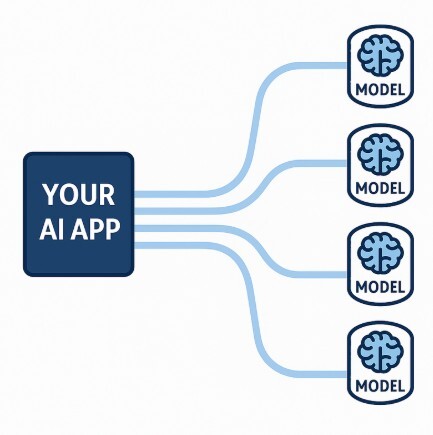
Yes, there are over 70,000 AI startups worldwide—but peel back the layers, and you’ll find the same few foundational models powering
most of them. The real engines? Just a handful:
OpenAI’s GPT family
Anthropic’s Claude
Google’s Gemini
Meta’s Llama
Amazon’s Bedrock (which itself uses third-party models)
And a few others like Mistral and Cohere.
The numbers prove it:
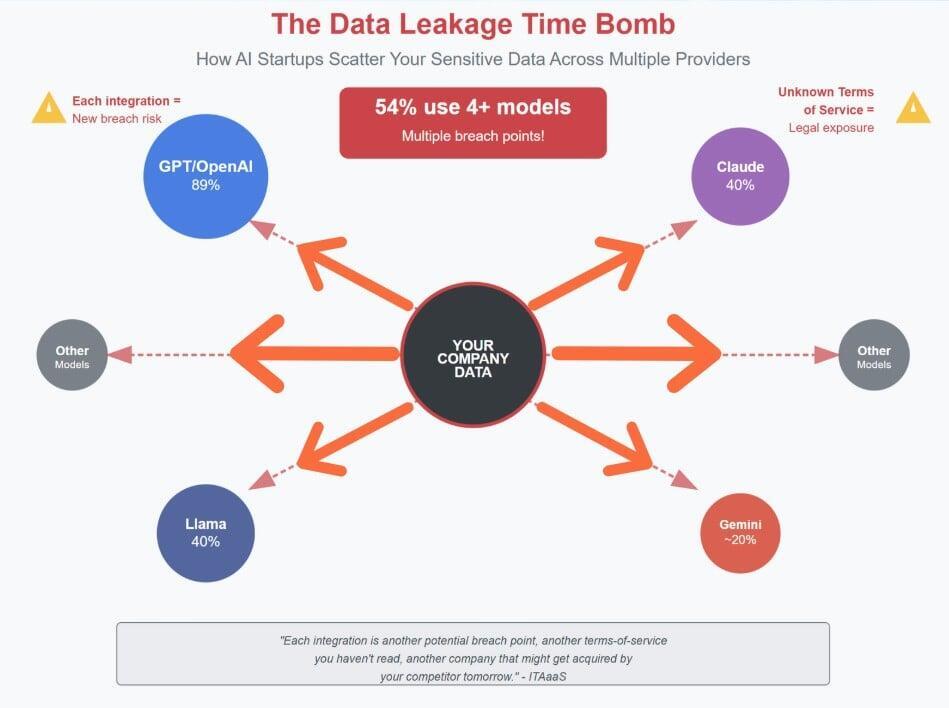
89% of AI startups use OpenAI’s GPT models
40% use Llama
40% use Claude
54% use four or more foundational models
Orrin Francis, CTO at ITAaaS, explains:
"Most ‘AI companies’ are just elaborate wrappers on top of someone else’s technology. They’re charging premium prices for a pretty
front-end to an API anyone can access. It’s like selling bottled tap water—sure, the label looks nice, but it’s still just tap water."
The Data Leakage Time Bomb
This multi-model reality comes with a dark side:
Your data isn’t going to one AI model—it’s potentially going to
five or six.
Each model, each API call, each integration… it’s another potential exposure point.
Another terms-of-service you haven’t read.
Another company that could get acquired by your competitor tomorrow.
Orrin Francis, CTO at ITAaaS, warns:
"Your sensitive business data could be scattered across half a dozen providers’ servers—each with their own risks, terms, and unknowns. If you don’t know where your data is going, you’re not in control."
The Black Box Problem: When AI Can’t Show Its Work
AI’s opacity is a ticking time bomb for regulated industries.
Whether it’s a credit decision, a loan application, or a medical diagnosis, AI systems often can’t explain their reasoning. That’s a massive issue when regulators come knocking.
Orrin Francis, CTO at ITAaaS, pulls no punches:
"Imagine telling a loan applicant ‘the computer said no’, and not being able to explain why. That’s not just bad customer service—it’s a lawsuit waiting to happen. In regulated sectors, the inability to show a clear chain of reasoning isn’t just problematic—it’s potentially illegal."
The Hype Cycle Strikes Again
This isn’t the first tech frenzy we’ve seen:
The dot-com bubble of 2000
The blockchain mania of 2017
The metaverse madness of 2021
Pat Devlin sums it up:
"We’re watching the same pattern unfold: massive hype, indiscriminate investment, widespread failure, then eventual stabilisation around a few real use cases. The difference this time? The stakes are higher, and the technology is more invasive."
Why Companies Keep Betting Despite the Odds
Because the upside is enormous. Companies that get AI right are seeing:
3X higher ROI than those just testing
30% time savings across initiatives
$500,000+ revenue gains from customer service bots alone
Pat Devlin acknowledges this appeal:
"The promise of AI is real. But promise and delivery are two very different things. Right now, we’re long on promise—and short on delivery."
The Path Forward: Speed, Not Haste
The answer isn’t to slam the brakes on AI—it’s to approach it wisely. ITAaaS recommends:
Start with the problem, not the technology
Know your vendor stack: What models power your AI? Where does your data go?
Build in explainability from day one
Establish robust governance frameworks
Move with speed—not haste
Pat Devlin:
"We’ve been through every major technology wave over the past three decades. We’ve seen where the bodies are buried. AI is transformative—but transformation without planning is just expensive chaos."
The ITAaaS Perspective: Survive the Gold Rush, Don’t Get Buried In It
AI will transform business—no doubt. The question is whether your business will survive the transformation.
Pat Devlin concludes:
"With proper planning, governance, and a healthy dose of scepticism, you can be among the winners, not another cautionary tale."
ITAaaS helps organisations navigate complex technology transformations safely and successfully. From AI implementation to comprehensive IT strategy, we bring decades of experience to ensure your innovation delivers real value, not just expensive lessons.